

Best Impact Windows for Salt Air Corrosion Resistance

Salt air doesn't care that your windows passed a hurricane test. Along the Gulf, the spray that drifts inland every day is what slowly eats at frames, hinges, and screws, and the damage is usually well along before anyone sees it.
If you are picking the best impact windows for salt air corrosion, the glass and the impact rating are only half the job. The frame material, the finish, the hardware alloy, and the way the window is installed decide whether it still opens, locks, and seals ten years from now.
Door Depot of SW Florida manufactures, assembles, and installs its own windows and storm protection products rather than reselling third-party lines. That means we see how these parts age on Sarasota, Manatee, and Charlotte County homes, and this guide sticks to what holds up near the water.
How salt air damage starts on window frames and hardware
Chloride-laden spray settles hardest on Gulf-facing walls, and it works its way into every small gap it finds: scratches in the finish, cut edges, and the heads of fasteners. Corrosion begins at those weak points long before the frame face looks any different.
On salt-exposed window systems, corrosion usually starts at the weakest metal, such as a fastener head, a hinge pin, or a lock component, or at a scratch in the finish, and then spreads under the coating.
That is why a window can look fine from the street while the damage is already working underneath. Paint-like finishes hide the problem until they bubble or flake.
The homes that take the worst of it sit on the water or within a short walk of it, with walls facing the Gulf or open bay. If that describes your house, treat every metal part on the window as a possible starting point, not just the frame.
Coastal window frame materials that resist salt corrosion
Here are the frame options ranked on salt-corrosion behavior alone. Where two are close, UV stability and upkeep break the tie. This list is about corrosion only, so for cost, strength, and looks, read the broader aluminum vs. vinyl comparison.
Fiberglass composite: no exposed metal in the frame, so there is nothing to rust. Color needs to be UV-stable.
Reinforced vinyl: no exposed metal on the frame either. Same UV caveat, and it needs the same attention to color terms.
Aluminum with a high-performance finish: a sound frame that resists salt only while its finish stays intact.
Aluminum with a basic finish: the most exposed option, because one scratch gives salt a way in.
The ranking says nothing about which frame is the better window overall. It only answers which one survives salt best with the least fuss.
Aluminum: a sound base that depends on its finish
Aluminum is a workable coastal frame, and it is the one most Florida homes already have. Its resistance to salt, though, comes mostly from what is applied to it, so the frame holds up near the coast only while that finish stays unbroken.
Once a chip or deep scratch exposes bare metal, salt and moisture can creep under the coating and lift it from the edges. You can slow that with the right finish and careful installation, which the next two sections cover. You can't skip them.
Reinforced vinyl and fiberglass: no exposed metal, but UV still matters
Reinforced vinyl and fiberglass composite frames have no exposed metal to rust. Salt spray simply has less to attack on the frame itself.
Sun is the other half of the story. Prolonged Florida sun can fade or chalk the color, so UV stability belongs in the spec alongside corrosion resistance. Ask for the color and UV terms in the manufacturer's spec sheet, and don't assume a white or tan frame will stay that way without them.
Neither material fixes the hardware. A fiberglass frame with weak hinges and plated screws will still rust where it counts.
Coatings and finishes that hold up to salt on aluminum frames
If you are leaning toward aluminum, the finish is the single most important line on the quote. Three types come up most often on coastal projects, and they behave differently.
Powder coat versus anodizing
Powder coat is a dry paint baked onto the frame as a film. It protects well, but only while that film stays unbroken, so a gouge from a ladder or a cut edge left bare during fabrication becomes the entry point for salt.
Anodizing works differently. It builds an oxide layer into the metal surface instead of sitting on top of it, so there is no film to peel away from the aluminum. It can still be scratched, but the protection is part of the metal.
High-performance fluoropolymer finishes are a common upgrade for coastal projects. They are formulated for tougher weather exposure than a standard powder coat, and they are worth asking about when the wall faces the Gulf.
Ask three things before you accept any aluminum window quote:
Which finish type is it, by name?
What pretreatment goes on the metal before the finish is applied?
What does the written warranty say, and does it exclude coastal or salt exposure?
Some finish warranties do exclude coastal or salt exposure, so the written terms are worth reading before you sign. A warranty that goes quiet on salt is not much use five blocks from the beach.
Why scratches and cut edges matter more than the label
A label such as "coastal-grade" tells you the intent, not the result. What matters is whether the finish is intact where salt actually lands: at corners, at cut ends, around screw holes, and along the sill.
Handling during delivery and installation causes more of this damage than weather does. Windows that are dragged, shimmed hard against block, or drilled on site pick up small breaks in the coating that never get touched up. A manufacturer that also installs can keep those steps under one roof, which is one reason we build and install our own units.
Marine-grade window hardware and fasteners that resist corrosion
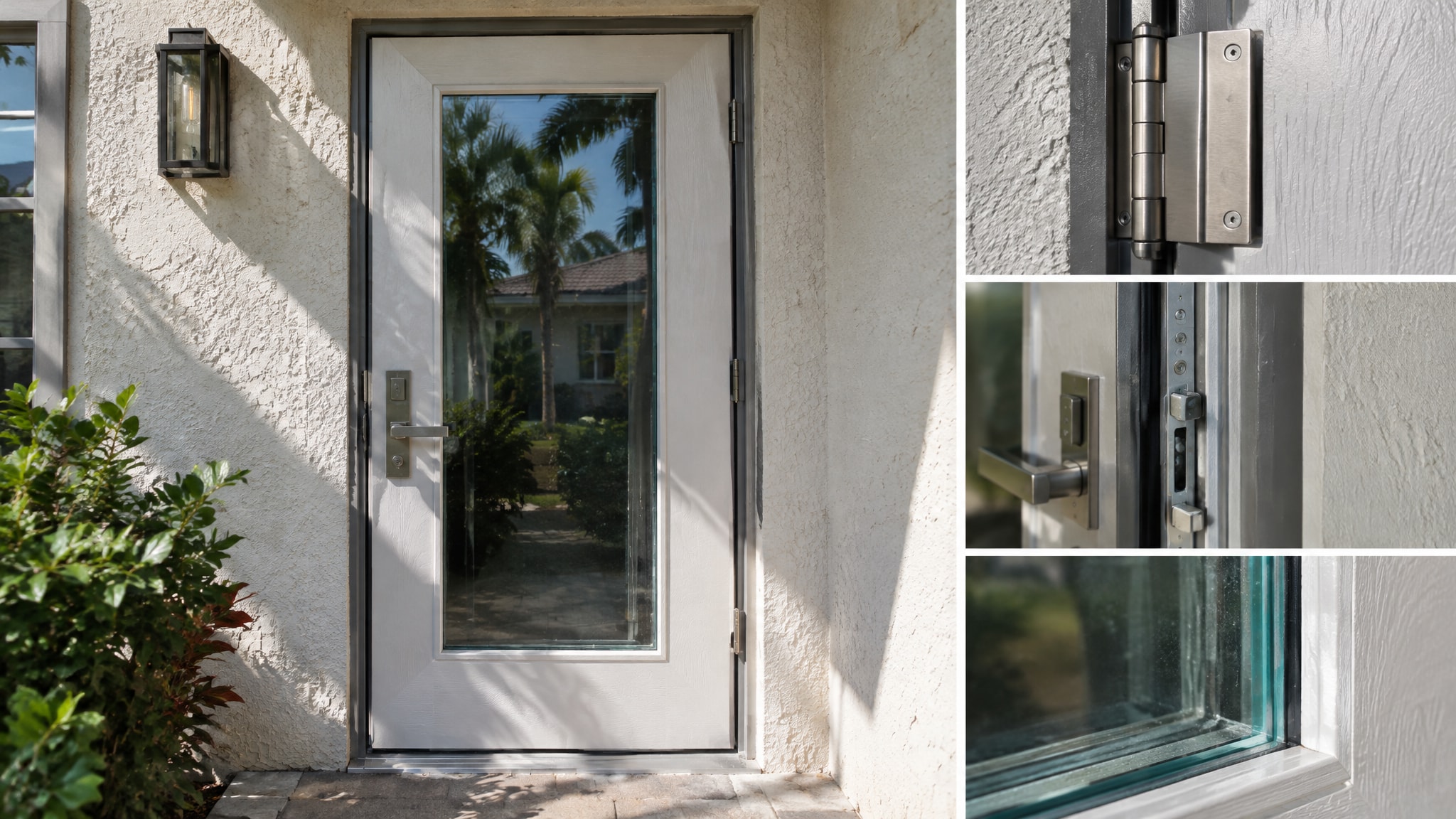
Hinges, locks, operators, and screws are small and cheap compared with the frame. They are also the first parts to show rust on a salt-exposed window, and a seized hinge makes a perfectly good frame useless.
Marine-grade stainless versus coated steel
Marine-grade stainless is the target for exposed hardware and fasteners. It is a molybdenum-bearing alloy, which is what separates it from standard stainless steel, and it is typically sold as 316. Standard stainless resists rust inland but can stain and pit in constant salt exposure.
Coated steel can last where its coating stays intact. The trouble is that cut edges, threads, and worn spots lose that coating first, and rust starts there. Zinc-plated or unspecified steel is usually where salt damage begins, so treat a spec that simply says "stainless" or "corrosion-resistant" with suspicion.
Ask for the alloy by name. A finish label tells you how a part looks. The alloy tells you what happens when the finish wears through.
Hinges, locks, and screws: the parts that fail first
On a casement or awning window, the hinge pins carry the load and sit right where moisture collects. Lock parts have moving surfaces that salt can seize. Fastener heads sit exposed on the frame and show rust streaks down the wall.
Because these parts are small, they are easy to leave off a spec sheet. Make sure the quote lists the hardware material, not just the window model, and you can compare two bids on equal terms. This approach won't make hardware immortal. Moving parts near salt water still need care, which we cover below.
Installation choices that slow galvanic corrosion
A window can be built with perfect materials and still corrode early if the install puts the wrong metals together. Galvanic corrosion happens when two different metals touch in the presence of moisture, and salt water is an excellent conductor. The softer metal, usually the aluminum, pays for it.
Three choices make the difference, and you can ask your installer about each of them: keep aluminum and steel apart, use corrosion-resistant anchors in block or stucco, and seal and drain the sill so water doesn't sit against the metal. For the full sequence from removal to final seal, see what the installation involves.
Isolation, sealing, and drainage at the sill
Isolation means a barrier between dissimilar metals, so a steel screw or bracket never touches bare aluminum. Anchors going into block or stucco should be corrosion-resistant too, because they are buried where you can't inspect them later.
The sill gets the most standing water, so sealing and drainage matter most there. A sill that sheds water and dries quickly gives salt less time to do its work. A sill that holds a puddle after every storm will eventually show it on the frame.
Good installation cannot rescue the wrong materials, and the right materials are not enough if the install ignores these steps.
Maintenance that slows corrosion between storm seasons
Salt builds up quietly, and the cheapest protection you have is washing it off. You don't need a special program, just a habit.
A simple rinse and inspect routine
Rinse the frames and hardware with fresh water after salt-heavy weather, such as a stretch of onshore wind or a storm that pushes spray inland. Use a hose, not a pressure washer, and skip abrasive cleaners and scouring pads, which scratch the finish and open the door to the corrosion you are trying to avoid. Mild soap and a soft cloth are enough.
Put a marine-suited lubricant on moving hardware, such as hinges and operators, so salt and moisture don't seize them.
Then look. Walk around the house and check for three things:
chips or scratches that expose bare metal
a chalky film on the frame surface
rust-colored staining below screws or hinges
Catch a chip early and a touch-up can stop the spread. Let it sit through a wet season and the coating lifts. The same hardware habits apply to your overhead door, so our garage door maintenance checklist is worth a read while you are at it.
Impact windows that resist salt air corrosion: what to ask before you buy
The best windows for Gulf Coast homes are the ones with documented answers on finish, hardware, and installation, not just a strong impact rating. An impact rating shows how a window assembly handles debris and pressure testing. It does not, on its own, show how the finish and hardware will hold up after years of salt exposure.
So ask for those papers separately. Check the product approval paperwork for the exact frame and glass, then request the finish and hardware details in writing.
Use this list when you compare quotes:
Finish type and coastal warranty terms: powder coat, anodized, or fluoropolymer, and whether the warranty excludes salt or coastal exposure.
Hardware alloy: named marine-grade stainless for hinges, locks, and screws, not "stainless" or "plated."
Fastener and isolation method: corrosion-resistant anchors, and a barrier between aluminum and steel.
Frame color and UV terms: required for fiberglass composite and reinforced vinyl.
Sill sealing and drainage: how it is done, and by whom.
If you are still early in the process, start with how to choose hurricane impact windows for a Florida home. When you are ready to budget, look at impact window pricing in Sarasota County and the financing options for impact windows, since upgraded finishes and hardware change the number.
We manufacture, assemble, and install our own windows, so we control quality and pricing from production through installation. If you own a home or build in Sarasota, Manatee, or Charlotte County, request a quote from Door Depot of SW Florida for impact windows specified for salt exposure. Bring the questions above, and tell us how close the wall sits to the water.
Frequently asked questions
Does an impact rating mean my windows will resist salt corrosion?
No. An impact rating covers debris and pressure testing, not long-term salt exposure. Ask separately for the finish type, the hardware alloy, and the written warranty terms.
Is aluminum a bad choice for a house near the Gulf?
Not by itself. Aluminum holds up near the coast only while its finish stays intact, so the finish type, the pretreatment, and careful handling during installation matter a great deal. If you want no exposed metal on the frame, reinforced vinyl and fiberglass composite are the alternatives, though they need UV-stable color.
Is regular stainless steel good enough for window hardware near salt water?
Usually not. Marine-grade stainless, a molybdenum-bearing alloy typically sold as 316, is the better target for exposed hinges, locks, and screws. Zinc-plated or unspecified steel is usually where salt damage begins.
How do I care for coastal windows between storm seasons?
Rinse frames and hardware with fresh water after salt-heavy weather, and use mild soap rather than abrasive cleaners. Apply a marine-suited lubricant to moving hardware. Look for chips, a chalky film, or rust-colored staining so you can touch up problems early.
What should I check in a finish warranty?
Read whether it excludes coastal or salt exposure, because some do. Also confirm the finish type and the pretreatment in writing. A warranty that doesn't cover salt offers little protection on a Gulf-facing wall.
That's Not My Neighbor gets interesting when players stop rushing through inspections and start noticing the little things. A visitor's photo, answers, or paperwork can reveal more than you might expect.